

What Is the Real Difference Between a Foldscope and a Traditional Compound Microscope?
A foldscope is an origami-inspired, paper-based microscope that costs under $2 and delivers 140x magnification, while a traditional compound microscope uses multiple glass lenses, costs $100–$5,000+, and magnifies 40x to 1,000x. The foldscope prioritizes portability and accessibility for field research and education in resource-limited settings. Compound microscopes excel in laboratory precision, durability, and professional use. Both are valid tools—the choice depends on your budget, mobility needs, and magnification requirements. In 2026, foldscopes have become mainstream in STEM education, while compound microscopes remain the gold standard for serious scientific work and clinical diagnostics.

Understanding these core differences helps educators, students, and researchers select the right instrument. Foldscopes democratize microscopy by removing cost barriers. Compound microscopes provide superior image quality and longevity for institutional settings. Neither replaces the other; they serve complementary purposes in modern science education and field exploration.
How Much Do Foldscopes and Compound Microscopes Cost?
Price is perhaps the most dramatic difference between these two instruments. A foldscope costs $1.50–$2.00 per unit, making bulk purchases affordable for entire classrooms or field teams. A basic compound microscope starts at $100–$300 for student-grade models. Professional laboratory-grade compound microscopes range from $500 to $5,000 or more, depending on lens quality, magnification range, and additional features like phase-contrast or fluorescence capabilities.

For schools with tight budgets, foldscopes enable universal access to microscopy. A single school budget can purchase hundreds of foldscopes, whereas compound microscopes limit quantity. However, compound microscopes represent a one-time investment that lasts 10–20 years with proper maintenance. Foldscopes, being paper-based, may require replacement after 6–12 months of heavy use.
- Foldscope cost: $1.50–$2.00 per unit; minimal maintenance expenses.
- Student compound microscope: $100–$300; lasts 10+ years with care.
- Professional compound microscope: $500–$5,000+; used in labs and hospitals.
- Bulk purchasing: Foldscopes win for classroom-wide distribution; compound microscopes for institutional investment.
Key Takeaway: Foldscopes dominate on affordability; compound microscopes provide better long-term value for serious scientific work.
What Magnification and Image Quality Can Each Provide?
Foldscopes deliver fixed 140x magnification, sufficient to observe cells, bacteria, and small organisms. Image quality is good for educational purposes but lacks the clarity of high-end compound microscopes. The single-lens design produces some chromatic aberration and limited depth of field. Despite these limitations, foldscopes reveal cellular structures clearly enough for teaching basic biology and conducting field surveys.
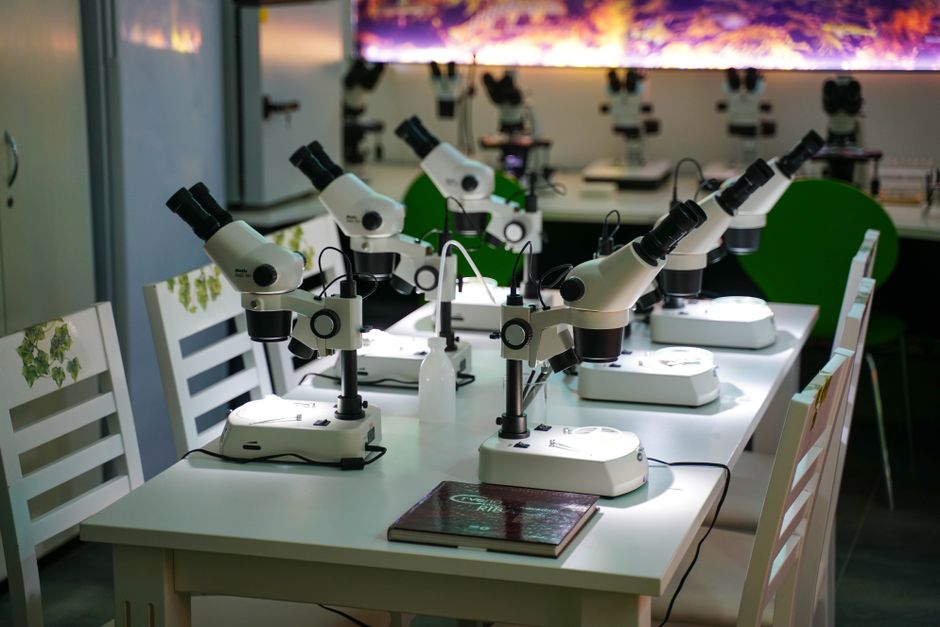
Traditional compound microscopes offer variable magnification: 40x, 100x, 400x, and 1,000x objectives. This flexibility allows users to zoom from tissue samples to individual bacteria. Multi-lens systems reduce aberrations and provide sharper, brighter images. Professional models include oil-immersion lenses for maximum clarity at 1,000x magnification, essential for identifying pathogens or examining fine cellular detail.
Magnification Comparison
- Foldscope: Fixed 140x; ideal for cells, algae, and insects.
- Student compound: 40x–400x; covers most educational needs.
- Professional compound: 40x–1,000x with oil immersion; clinical and research standard.
- Image clarity: Compound microscopes outperform foldscopes at all magnifications.
For classroom observation of pond water, plant cells, and microorganisms, foldscopes are perfectly adequate. For identifying unknown bacteria or diagnosing diseases, compound microscopes are non-negotiable. Read our detailed guide on foldscope 140x magnification cell examples to see what you can actually observe with a foldscope in 2026.
Key Takeaway: Foldscopes offer fixed 140x magnification suitable for education; compound microscopes provide variable, professional-grade magnification for advanced work.
Which Is More Portable and Suitable for Field Research?
Portability is a foldscope’s defining strength. Weighing less than 10 grams and fitting in a pocket, foldscopes enable researchers to conduct microscopy in remote locations, schools without labs, and field expeditions. They require no electricity, no water, and minimal setup time. A single backpack can carry hundreds of foldscopes for large-scale field surveys. This mobility has revolutionized citizen science and global health diagnostics in developing regions.

Compound microscopes are stationary instruments. Even portable student models weigh 5–10 pounds and require a stable surface, electricity (for illumination), and careful handling. They are designed for fixed laboratory or classroom settings. Moving a compound microscope risks misalignment and damage to delicate optics. For fieldwork, compound microscopes are impractical unless transported in protective cases and set up in a temporary lab space.
Portability and Fieldwork Advantages
- Foldscope: Pocket-sized, weighs under 10 grams, requires no electricity.
- Compound microscope: Stationary, 5–20 pounds, needs stable surface and power.
- Field research: Foldscopes dominate for remote and resource-limited settings.
- Lab work: Compound microscopes are the practical choice for controlled environments.
In 2026, foldscopes have become the instrument of choice for environmental monitoring, disease surveillance in rural areas, and educational outreach. They enable researchers to collect data where compound microscopes cannot go. However, for returning samples to a laboratory for detailed analysis, compound microscopes remain essential.
Key Takeaway: Foldscopes win decisively on portability and fieldwork capability; compound microscopes require fixed laboratory infrastructure.
How Do Educational Applications Differ Between the Two?
Foldscopes have transformed science education by making microscopy accessible to every student. Teachers can distribute one foldscope per student, allowing hands-on exploration without sharing equipment. The low cost eliminates concerns about breakage. Students can take foldscopes home to conduct independent research projects. This democratization has increased engagement and equity in STEM learning, particularly in underfunded schools and developing countries.

Compound microscopes remain the gold standard for advanced biology courses and university-level instruction. Students learn proper microscope handling, lens care, and multi-magnification techniques. Compound microscopes teach discipline and precision. They are essential for anatomy, microbiology, and pathology curricula. Many schools maintain both instruments: foldscopes for introductory lessons and exploration, compound microscopes for advanced study.
Educational Use Cases
- Foldscope strengths: Universal access, hands-on learning, field investigations, low cost per student.
- Compound microscope strengths: Advanced curricula, professional technique, multi-magnification skills, institutional credibility.
- Best practice: Combine both tools—foldscopes for discovery, compound microscopes for mastery.
- 2026 trend: Schools increasingly adopt foldscopes alongside traditional microscopes.
The Foldscope 2.0 Explorer Kit for high school exemplifies this integrated approach, pairing foldscopes with digital documentation tools for modern STEM education.
Key Takeaway: Foldscopes democratize microscopy in education; compound microscopes provide advanced training and professional credibility.
What Are the Practical Advantages and Limitations of Each?
Foldscope Advantages and Limitations
Advantages: Foldscopes cost nearly nothing, require no maintenance, need no electricity, and fit in a pocket. They are ideal for rapid field surveys, citizen science projects, and introducing microscopy to novices. Paper construction is biodegradable and environmentally friendly. Digital adapters allow smartphone image capture, enabling easy data sharing and documentation.
Limitations: Foldscopes offer fixed 140x magnification only. Paper construction is fragile and deteriorates with heavy use. Image quality is adequate but inferior to compound microscopes. They cannot perform specialized techniques like oil immersion, polarized light, or fluorescence microscopy. For serious diagnostic or research work, foldscopes are insufficient.
Compound Microscope Advantages and Limitations
Advantages: Compound microscopes deliver variable magnification, exceptional image clarity, and durability. They enable advanced techniques including oil immersion, phase contrast, and fluorescence. Professional models are used in hospitals, research labs, and quality-control facilities. A single compound microscope can serve hundreds of students over decades.
Limitations: High upfront cost limits quantity purchases. They require electricity, stable surfaces, and proper maintenance. Portability is poor. Learning curve is steeper for beginners. Repairs and replacement lenses are expensive. They are unsuitable for field research in remote or resource-limited locations.
- Foldscope: Cheap, portable, simple, but fixed magnification and fragile.
- Compound microscope: Powerful, durable, versatile, but expensive and stationary.
- Hybrid strategy: Use foldscopes for exploration and field work; compound microscopes for advanced analysis.
Key Takeaway: Foldscopes excel in accessibility and fieldwork; compound microscopes dominate in capability and precision.
How to Choose Between a Foldscope and a Compound Microscope for Your Needs?
Your choice depends on five key factors: budget, magnification requirements, portability needs, intended use, and user experience level. If you have a limited budget and need to equip many learners, foldscopes are the clear winner. If you require variable magnification, professional image quality, or advanced techniques, invest in a compound microscope. Consider whether your work is stationary (lab-based) or mobile (field-based).
For schools, the optimal strategy is to purchase both. Foldscopes introduce students to microscopy affordably and engagingly. Compound microscopes provide advanced training for serious students and support advanced curricula. This combined approach maximizes learning outcomes and meets diverse educational needs. In 2026, many progressive schools have adopted this dual-instrument model.
Decision Framework
- Choose foldscope if: Budget is tight, you need portability, serving many learners, conducting field surveys.
- Choose compound microscope if: Quality matters, variable magnification needed, stationary lab setting, advanced techniques required.
- Choose both if: Running a school, supporting diverse curricula, combining education with field research.
- Ask yourself: What magnification do I need? Where will I use it? How many users? What is my budget?
Start with a clear inventory of your actual needs. Will you observe cells or bacteria? Do you need to work outdoors? How many students or researchers will use the instrument? Once you answer these questions, the choice becomes obvious. Many educators find that foldscopes and compound microscopes are not competitors—they are complementary tools serving different purposes in modern science.
Key Takeaway: Match your instrument to your specific needs: foldscopes for accessibility and fieldwork, compound microscopes for capability and precision.
What Does the Future Hold for Microscopy in 2026 and Beyond?
In 2026, foldscope technology continues to evolve. Newer models offer improved optics, better smartphone integration, and enhanced durability. The original vision of democratizing microscopy is becoming reality in schools and field research programs globally. Foldscopes are no longer novelties—they are standard tools in biology education and global health initiatives. Manufacturers are exploring color imaging, higher magnifications, and specialized filters for different applications.
Compound microscopes are integrating digital imaging, artificial intelligence for automated analysis, and connectivity features for remote collaboration. Professional-grade systems now include AI-powered identification of pathogens and automated slide scanning. The gap between foldscopes and compound microscopes is narrowing in some ways while widening in others. Foldscopes are becoming more capable; compound microscopes are becoming smarter and more connected.
The future belongs to integrated microscopy systems that combine the accessibility of foldscopes with the power of compound microscopes. Hybrid approaches—using foldscopes for initial screening and compound microscopes for detailed confirmation—are becoming standard in field epidemiology and environmental monitoring. Both instruments will coexist and thrive in different niches.
Key Takeaway: Foldscope and compound microscope technologies will continue to evolve separately and may integrate into hybrid workflows in specialized fields.
Frequently Asked Questions
Can a foldscope replace a traditional compound microscope?
No. Foldscopes are excellent for education and fieldwork but lack the magnification, image quality, and advanced capabilities of compound microscopes. For professional diagnostics, research, and advanced curricula, compound microscopes are essential. Foldscopes and compound microscopes serve complementary roles rather than competing directly.
How long does a foldscope last compared to a compound microscope?
A foldscope typically lasts 6–12 months with regular use due to its paper construction. A compound microscope lasts 10–20+ years with proper care and maintenance. Compound microscopes represent a better long-term investment for institutions, while foldscopes are consumable items suited to frequent replacement and distribution.
Are foldscopes suitable for identifying bacteria and viruses?
Foldscopes can observe larger bacteria at 140x magnification but cannot identify viruses or smaller bacteria reliably. Compound microscopes with 1,000x magnification and oil immersion are necessary for bacterial identification and clinical diagnostics. Foldscopes are better suited to observing cells, algae, and larger microorganisms.
What is the best microscope for a homeschooling family in 2026?
For budget-conscious homeschoolers, start with a foldscope ($2) to introduce microscopy and explore nature. For deeper learning, add an affordable student compound microscope ($100–$300) offering 40x–400x magnification. This combination provides both accessibility and capability for comprehensive science education at home.
Can foldscopes be used with smartphones for imaging?
Yes. Foldscope 2.0 models and adapters enable smartphone attachment for image and video capture. Digital documentation enhances learning and allows easy data sharing. Compound microscopes also support smartphone adapters, though dedicated microscope cameras provide superior image quality for professional work.
Which microscope is better for environmental field research?
Foldscopes are superior for environmental fieldwork due to portability, durability, and zero maintenance requirements. Researchers can conduct rapid surveys of water samples, soil organisms, and insect specimens in remote locations. Compound microscopes are impractical for field deployment but essential for laboratory analysis of collected samples.
Should You Choose a Foldscope or a Compound Microscope in 2026?
The answer is not either-or but rather both-and. Foldscopes have revolutionized microscopy access, making it possible for every student and researcher to observe the microscopic world. Their $2 cost, pocket-sized design, and zero-maintenance operation make them ideal for education, fieldwork, and global health initiatives. Compound microscopes remain the gold standard for professional science, advanced diagnostics, and institutional learning. In 2026, the smartest approach combines both instruments strategically.
If you are an educator, purchase foldscopes for universal student engagement and field investigations. Maintain a few compound microscopes for advanced courses and precise work. If you are a researcher, use foldscopes for rapid field surveys and preliminary screening. Return promising samples to a laboratory equipped with compound microscopes for detailed analysis. If you are a student or hobbyist, start with a foldscope to explore, then upgrade to a compound microscope as your interests deepen and your budget allows.
Both instruments have earned their place in modern science. The future of microscopy is not about choosing between them—it is about using each tool where it excels. In 2026 and beyond, the most effective scientific programs will integrate foldscopes and compound microscopes into cohesive, complementary workflows that maximize learning, discovery, and impact.




Write Your Review
No reviews yet. Be the first to share your experience!